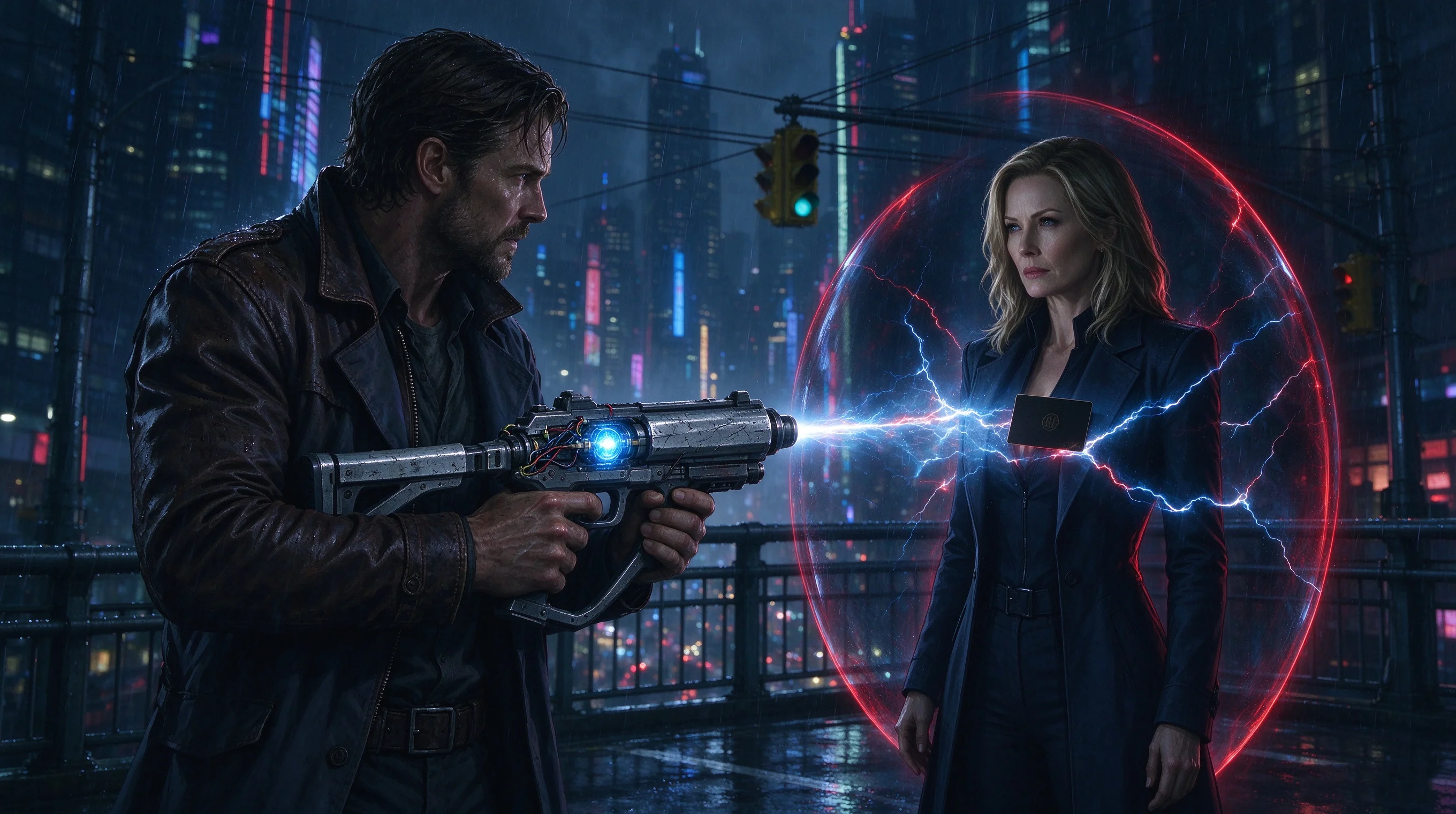
The Canvas of Time
Midnight in Portland. Detective Vincent pushed open the door to Julian’s studio.
The air smelled of turpentine. Julian stood before an easel, his brush dripping vermilion. His white shirt was smudged with color.
“You were near the scene again, Julian.” Vincent watched the artist’s back, the handcuffs in his pocket cold and heavy.
Julian turned. “I was documenting the light, Detective.” He smiled. “Besides, at eleven tonight—when it happened—I was sketching you.”
Vincent looked at the canvas. His own half-finished portrait stared back, eyes shadowed, right hand gripping handcuffs. The corner bore a timestamp: 11:00 PM tonight.
“That’s not an alibi.” Vincent stepped closer. “That’s a trap.”
Julian’s fingers grazed the detective’s collar, leaving a red smear on the uniform. “Will you arrest me for this paint, or keep it as evidence?”
The scent of pigments mixed with cinnamon on Julian’s skin.
Vincent stepped back. The cuffs clinked faintly as the studio lights flickered.
Julian set down his brush and pulled a folded sketch from a drawer. “Last week’s study. Care to see?”
The paper showed Vincent’s retreating figure. Dated: 3:00 PM Friday. Exactly when the third victim had been found.
“You’ve been following me.” Vincent’s finger found the trigger.
“And you’ve been following me, Detective.” Julian’s smile deepened. “We’re each other’s muse, aren’t we?”
Vincent scanned the walls—dozens of sketches, all of him: at the precinct, in cafés, by his car. The oldest dated back three months.
“Why draw me?”
Julian traced the canvas. “Your eyes hold a light. Like fire in the dark.”
Vincent raised the cuffs. Steel glinted under the unstable bulbs.
Julian stepped closer instead of back. “Arrest me. End this.”
Warm fingers closed around Vincent’s wrist through the fabric.
“Or,” Julian murmured, “stay. Finish the painting.”
On the canvas, the portrait-Vincent was clapping cuffs on someone outside the frame.
The studio phone rang.
Vincent’s pulse hammered. His phone buzzed—a text: Don’t trust him.
Julian added a stroke to the painting. “Someone warning you, Detective?”
The curtains behind the easel stirred, as if touched.
“Tonight’s sketch isn’t done.” Julian’s voice held a thread of amusement. “You’ll need to watch me finish.”
The cuffs hung heavy in Vincent’s grip. He knew better—yet couldn’t look away. The painted version of himself grew more vivid by the second.
Another buzz. Same message.
Julian’s fingertip brushed Vincent’s badge. “They’re afraid. You’re too close to the truth.”
Vincent stared at the easel. In the lower right corner of the canvas, a small inscription: To Be Continued.
He turned toward the door.
“Detective.” Julian’s voice trailed after him. “Next time, bring a red brush.”
Vincent’s hand froze on the doorknob. The scent of paint wafted behind him, mingling with something unnameable—danger, perhaps. The lights in the studio flickered out completely as the door clicked shut.
Outside, Vincent leaned against the wall, catching his breath. His phone buzzed again. A third message: Check his paint.
The next morning, in the forensic lab, the technician looked up from his microscope. “That red on your shirt—it’s not paint.”
“What is it?”
“Blood.”
Vincent sprinted back to the studio. The door was locked. He climbed through the back window. A new canvas sat on the easel, the unfinished portrait now featuring Vincent’s eyes—crimson, like blood. In the corner, a bucket of paint shimmered with metallic streaks. Gloved, he fished it out—a police badge.
The phone rang. Julian’s voice: “Do you like my new piece?”
In the background, sirens wailed. Close.
“You’re at my place?”
The line went dead. The sketches on the walls began to bleed. Vincent tore down the nearest one. On the back, scrawled: The evidence is in your drawer.
He raced back to the station. The third drawer of his desk, hidden compartment. Three crime scene photos, each with the same detail circled in red—the corner of an easel.
His phone chimed with a security alert. Someone was in his living room. The feed showed Julian painting on the wall, red dripping from the ceiling. Vincent drew his gun. On-screen, Julian turned, smiling at the camera. New words appeared on the canvas: Your turn to chase me.
Julian’s phone lay abandoned in the corner of the studio. The screen displayed a recent search: How to alter surveillance timestamps.
Vincent opened his workstation, typed Julian’s full name. A childhood photo appeared in the file—a boy standing by an orphanage wall, clutching a red crayon. In the corner, a blurred figure. Zoomed in, it was Vincent’s father, younger, the lead investigator on an old murder case.
The office door locked itself. The scent of cinnamon drifted from the vents. The monitor switched to a new feed. Julian stood in Vincent’s apartment, brushing red onto the wall. Not paint this time.
Vincent reached for his sidearm. One bullet missing.
The screen went black. Red text appeared: Let’s play a game.
The sprinklers activated, spraying water that reeked of rust. His phone buzzed again, the photo gallery opening automatically. It showed the paint bucket from earlier—zoomed in, the metallic glint at the bottom wasn’t a badge. It was a bullet casing.
The desk drawer oozed red. Vincent pried it open with his baton. Inside lay a dried red brush. The shaft was engraved with a date—his birthday, twenty years ago.
The footsteps in the hallway weren’t from dress shoes—they were the soft shuffle of canvas soles, the kind worn in art studios. The monitor flickered to life, Julian’s face filling the screen: "The day your father closed the case twelve years ago, who really died in that studio?"
The steps halted outside the door. As the knob turned, the computer displayed one final photo—the signature on the old case report matched Julian’s current artwork signatures exactly.
Vincent raised his gun. A metallic click sounded beyond the door—a round chambered. He held his breath. The door opened.
Julian stood there, a red paintbrush in hand. Blood dripped from its tip. "Game over," he said. Vincent pulled the trigger. A hollow click. Julian grinned. "Did you really think you could catch me?" He stepped inside, the brush carving an arc through the air. Vincent backed up, hitting the desk. The drawer slid open, revealing an unfinished painting—Vincent himself, holding a gun to his temple.
Julian took another step. "Your father did the same thing." Vincent stared at the canvas. "He never uncovered the truth," Julian murmured, tracing the brush along the painting. "But he captured the final act."
Vincent’s phone buzzed. A notification flashed: Case report amended. Julian turned toward the door. "One last chance," he said. Vincent looked down. A new red brush lay on the desk, the shaft engraved with today’s date.
The door shut. Silence swallowed the office. Vincent picked up the brush. His phone vibrated—the security feed activated. Julian stood in Vincent’s living room, smiling at the camera. "Your turn to paint," he said. Vincent’s hand trembled. The brush’s tip oozed red. Not paint. His fingers came away wet, warm. The feed cut abruptly. A third figure appeared behind Julian. Vincent’s breath caught—it was himself, twenty years younger.
A crack split his phone screen. Blood beaded along the fracture. The station plunged into darkness. In the black, the rapid scratch of pencil on paper. Emergency lights flickered on. Every painting in the office had changed. A new date marked each corner: tomorrow. A sticky note clung to the window. Vincent tore it free. Final deadline, scrawled in red. On the back—his father’s old badge number.
The computer booted on its own. The screensaver now counted down: 23:59:59. Vincent’s service weapon slid from its holster. An extra bullet sat in the magazine. Julian’s name was etched into the casing. Sirens blared. Julian’s voice crackled through the PA: "Check where that bullet was made." Vincent flipped the casing. Tiny print underneath: St. Mary’s Orphanage, 2003. His badge burned against his chest. The same address glowed on its reverse.
A photograph fluttered from the vent. Ten-year-old Julian stood in an art room, the gun in his hand. On the back, smeared in pencil: "Where were you then?"
The office mirror fractured. Two Vincents stared back—one in uniform, the other in pajamas printed with rockets. His phone screen lit up: security footage of his father’s gasping last words. "Check case file page forty-three."
Vincent sprinted to Records. Page 43 was blank—until the paper began weeping blood. He smeared it with his thumb. The stain resolved into a miniature: Julian guiding a smaller Vincent’s hand over crayon strokes. Cold steel pressed against his nape.
"Now you remember," Julian breathed behind him. Down the hall, the emergency exit swung open. A third Julian stood there—soaked in blood, clutching a badge. Vincent’s pulse hammered. That shield number was his own.
Canvas ripped behind him. The palette knife split his skin, but no blood came. Instead, a tiny painted square fluttered out. The bloody Julian raised the badge. Embedded in its back: a bullet matching Vincent’s service issue from yesterday.
Children’s voices swelled from the speakers—St. Mary’s choir singing their alma mater. File cabinet #43 slid open on its own. Inside, three shell casings formed a perfect triangle. The oldest bore his father’s name.
Vincent’s service weapon lurched in his grip. The bullet’s serial number seared his palm—20030516. The day he’d first met Julian.
The bloody Julian melted. Crimson tendrils arrowed across the floor toward Vincent’s badge. A pencil snapped behind him. The palette knife clattered down, its handle smeared with fresh blood forming words: "Time to close the case."
Static swallowed the choir. His father’s voice cut through: "Sign the report in red." Vincent tore off his badge. The embedded bullet dropped, hit the cabinet—and exploded into a storm of sketched fragments. Every scrap showed him and Julian at different ages. On the oldest, a child-Vincent scribbled wildly with a red crayon.
The date in the corner was today’s.
Silence. The bloody Julian was gone, leaving only a police uniform in Vincent’s exact measurements. Another photo drifted from the vent. Blank—until the paper scorched his fingers. Letters emerged in drying blood:
Your turn.
Transparency Disclosure: Content here is for informational and entertainment guidance. This publication maintains editorial independence, though some links may generate affiliate revenue. For copyright inquiries or content removal, please reach out to our desk.